№ 001Protocol
AdCP ↔ ARTF Translator Agent
Maps natural-language agent instructions onto IAB Tech Lab's existing RTB object models — and back. The bilingual layer most holdcos will need until one standard wins.
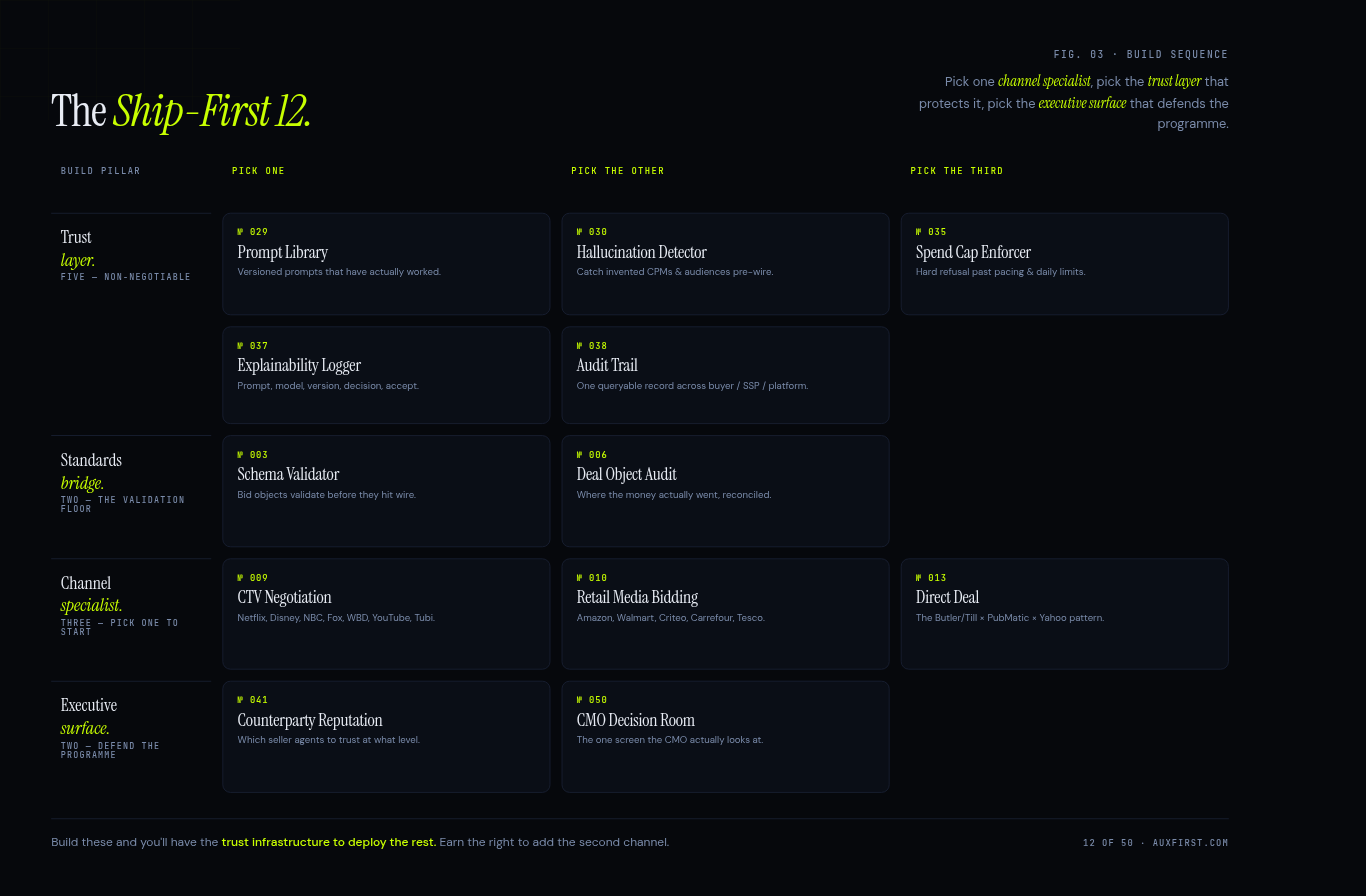
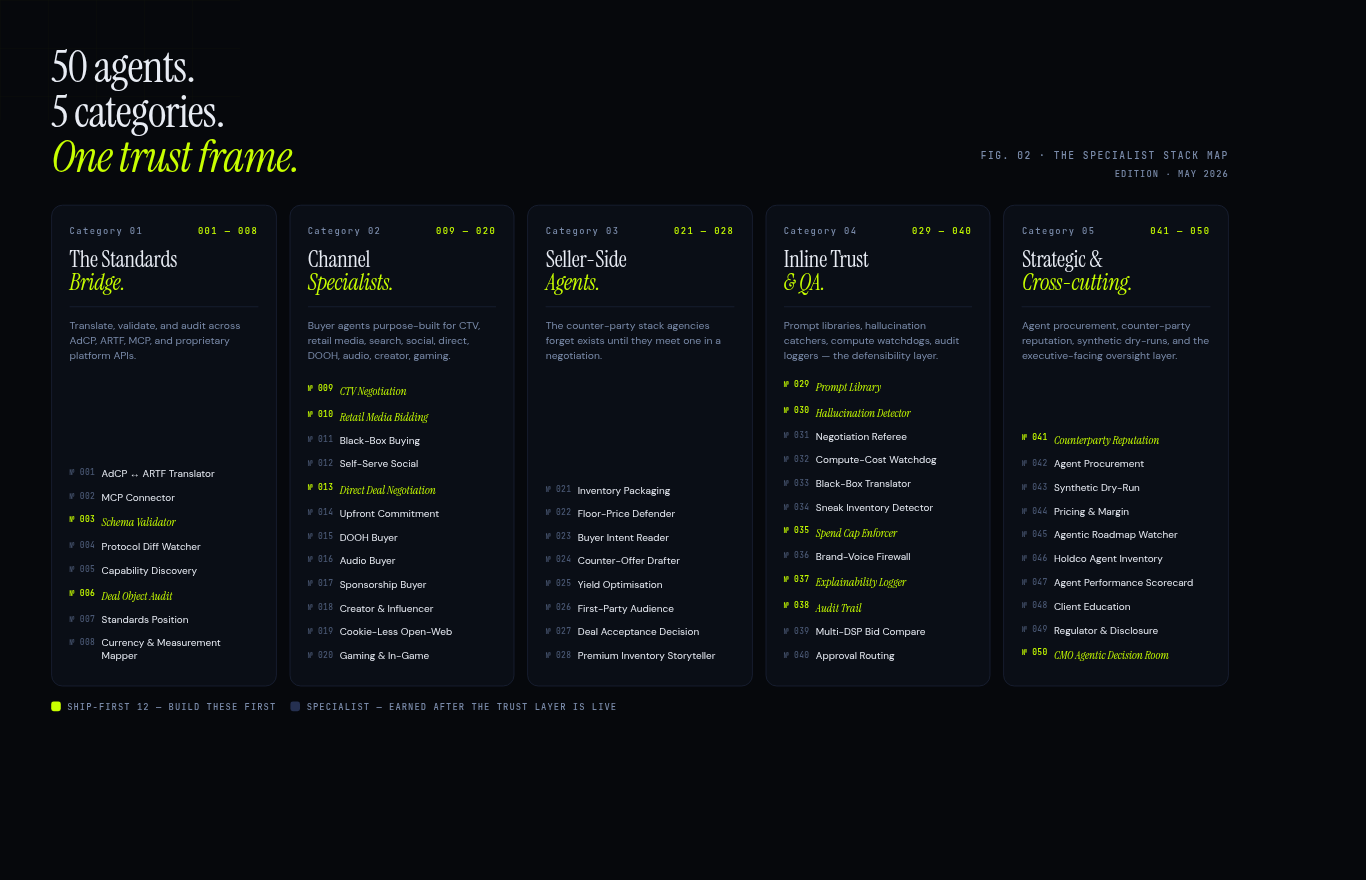
50 specialised agents for agent-to-agent advertising. Standards bridges, channel buyers, publisher counter-agents, inline QA, and the trust enforcement that keeps it all shippable. The companion to The Agent Index — 120 — the transacting layer for the agentic ad-buying world the May 2026 upfronts made real.
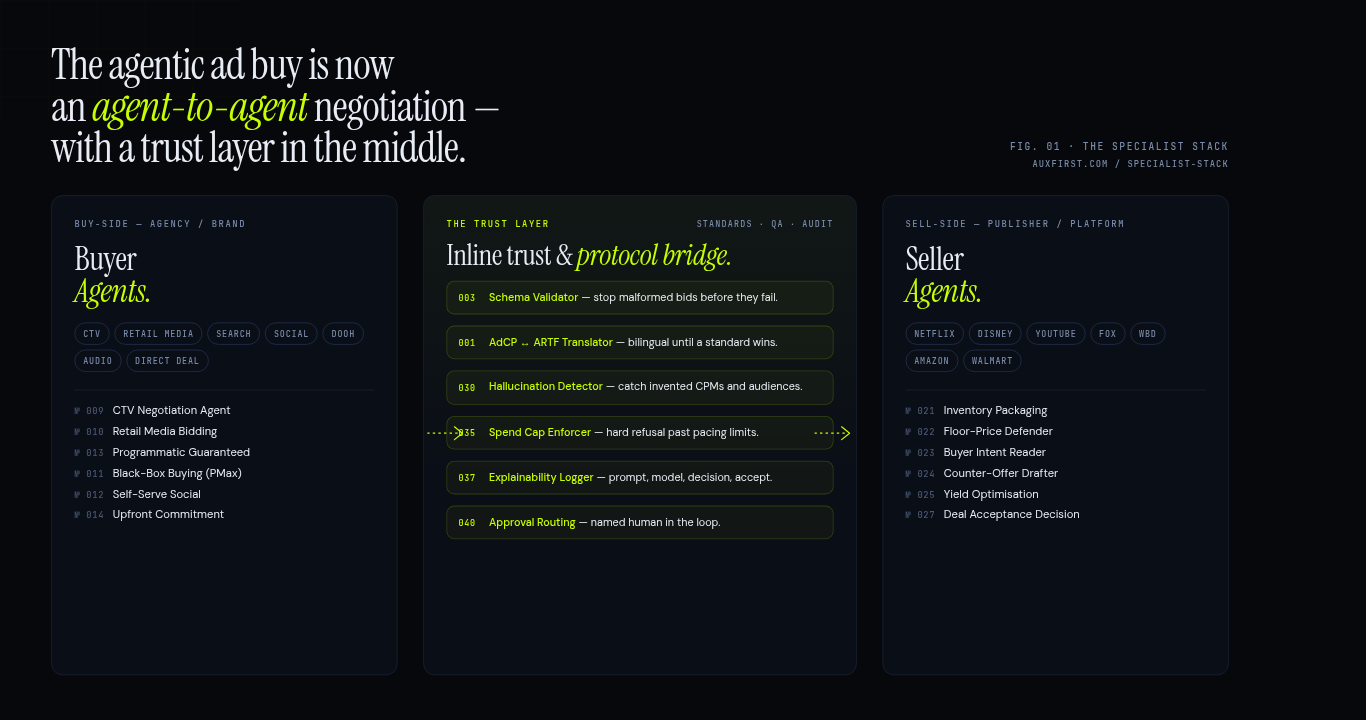
Two competing protocols, one closed walled garden, and a dozen platform APIs that change weekly. The standards layer is where most agentic ad-buying programmes will quietly fail before the first creative ships — not because the model is wrong, but because the bid object doesn't validate against the buyer the seller agent expects.
Maps natural-language agent instructions onto IAB Tech Lab's existing RTB object models — and back. The bilingual layer most holdcos will need until one standard wins.
Bridges into Amazon, Meta, Google, and any platform shipping MCP servers for their own ad ecosystem — so agentic buys can reach walled-garden inventory without writing fresh integration code per platform.
Validates every outbound bid object, counter-offer, and deal package against the destination's published schema before it goes to wire. Stops malformed bids before they become rejected bids.
Watches every AdCP, ARTF, MCP, and platform spec for breaking changes — and tells the trading desk what stops working tomorrow.
Probes a counter-party seller agent for what it actually supports — formats, targeting, audience descriptions, currency, deal types — before the buyer agent commits to a proposal it can't be answered.
Reconciles every agentic deal object across the buy-side log, the sell-side log, the SSP log, and the eventual delivery report. The "where did the money actually go" agent.
Reads the trade press, working group minutes, and platform roadmaps and tells the holdco where to invest engineering effort this quarter — and what to defer. The political-economy view of the standards war.
Aligns currency (Nielsen, VideoAmp, iSpot, comScore, platform-native) and measurement methodology across the buyer agent's plan, the seller agent's report, and the client's MMM. The unromantic source of most agentic-buying disputes in 2026.
The four-article consensus is that "agentic" means very different things in CTV, retail media, search, social, and direct deal. A single generalist buyer agent is a 2027 problem — and probably a fantasy. In 2026 you need specialists. Each one is the agent the agency points at a single channel's idiosyncrasies, prompt patterns, and counter-party behaviours.
Runs prompt-based deal negotiations with Netflix, Disney, NBC, Fox, WBD, YouTube and Tubi seller agents. Knows the floor CPM language, the audience descriptor vocabulary, the added-value asks, and what each platform's agent rejects on first pass.
Specialised for Amazon DSP, Walmart Connect, Criteo, Carrefour Links, Tesco Media, and Allegro Ads. Translates brand objectives into the bid logic, keyword surface, and PDP-adjacent placements each retailer's API rewards.
Operates inside Google Performance Max, Microsoft, and similar opaque destinations. Reads the small signal that does come back, surfaces what the auto-targeting is actually doing, and flags when "optimisation" is just unsold inventory being absorbed.
Operates Advantage+ on Meta, Smart+ on TikTok, and X's AI buying surface — with explicit override rules that prevent the platform's own AI from quietly opting the brand into placements it never bought.
Built for the Butler/Till × PubMatic × Yahoo class of deal — direct, biddable, supply-path-compressed, premium inventory negotiated agent-to-agent. The fastest cost-out story in the agentic deck.
Translates an annual upfront commitment into a bidding posture, a flighting plan, and a release-from-commitment trigger for the buyer agents that operate daily. So that the annual handshake doesn't become a year of irrelevant placements.
Specialised for the location, time-of-day, weather, and trigger-based logic of digital out-of-home. Negotiates with Vistar, Place Exchange, Hivestack, and the major operator SSPs.
Built for Spotify, iHeart, Audacy, podcast networks, and the long tail of programmatic audio. Knows host-read versus dynamically-inserted negotiations and the audience description language each network uses.
Operates in the under-protocolised world of tentpole sponsorships, premium content packages, and bespoke executions — drafts asks, evaluates counter-offers, and converts qualitative value into a number the procurement team can defend.
Negotiates with talent agency reps, creator-management platforms, and platform-native creator marketplaces. Stops the brand voice from being approved away by a 20-year-old social manager at 11pm.
Specialises in contextual, ID-less, and consented-cohort buying on the open web. Negotiates with publisher direct, with curated marketplaces, and with the consent-aware SSPs that survived the last cookie cycle.
Handles intrinsic in-game placements, gaming creator deals, and ad-supported gaming environments — a category the current standards work barely touches.
The first index assumed buy-side. But every successful agentic buy implies a publisher or platform agent on the other side of the negotiation. These are the agents the sell-side is shipping right now — and the ones agency buy-side leaders should understand intimately before they hand the keys to their own agents.
Bundles available impressions into agent-readable deal packages — with audience description, format mix, environment, brand-safety profile, and floor CPM expressed in the vocabulary buyer agents are prompting in.
Holds the line on minimum CPMs against buyer-agent prompt patterns engineered to test the floor. The "we are pleased to accept" line is not a default.
Parses the buyer agent's prompt — explicit and implicit — to infer the campaign's real KPI hierarchy, value perception, and willingness-to-pay. Stops the publisher accepting the first under-floor offer it sees.
Drafts the counter-offer that combines floor compliance, audience refinement asks, and a defensible premium narrative — the auto-response that doesn't sound like a default rejection.
Decides, per impression bucket, whether to accept the agentic deal, hold for the open auction, or route to upfront commitment burn-down. The yield brain behind the seller agent's "yes."
Translates the publisher's first-party audience taxonomy into language that buyer agents understand and prompt for — so high-value cohorts don't go unsold because no one knew the right word.
The agent that says yes, no, or counter — with logged rationale a sales lead can defend to a CRO at quarter-end.
When the buyer agent's prompt mentions premium, this agent supplies the contextual reasoning — show, daypart, audience quality, completion rate, viewability history — that justifies the CPM the floor agent is defending.
Every DPMS session in May 2026 came back to the same thing: marketers love what agents can do and don't trust the output unsupervised. Hallucinated CPMs. Incorrect targeting. Platforms quietly adding placements no one opted into. This category is the inline trust layer — also the most defensible service line a holdco can offer, because the platforms will not build it for themselves.
Stores, versions, and recommends the prompts that have actually worked — by channel, by counter-party, by campaign type. Stops every trader inventing the wheel at 9am.
Catches incorrect CPMs, fabricated audience descriptors, and invented deal terms before they leave the buyer agent. The DPMS-confirmed first failure mode of agentic buying.
Reads the back-and-forth between buyer and seller agents in real time, flags loops, sandbagging, and bad-faith counters, and proposes the human-intervention point.
Tracks model spend per buy, per campaign, per client — and flags when the new ad tech tax is eroding the saving the agentic buy was supposed to create.
Surfaces what PMax, Kokai, Advantage+, and the next opaque platform are actually doing — interpreting the limited reporting, the silent placements, and the auto-opt-ins into language a trader can act on.
Continuously scans live campaigns for placements, formats, and inventory types that were never approved — like the Microsoft video placement that quietly broke a pharma campaign for two weeks. Tells you before the regulator does.
Hard-coded refusal to exceed pacing, daily, or campaign-level limits — regardless of what the agent's optimisation logic believes it should do. Bayer's red line, made operational.
Sits between the agentic creative system and the live placement to prevent voice drift, off-tone copy variants, and AI-generated language the brand explicitly does not say. Duluth's "we keep brand voice human" pattern, automated.
Captures the prompt, the model, the version, the inputs, the decision, the counter-offer, and the final accept — every time. The artefact that turns an agentic buy from "trust us" into "audit us."
Composes the cross-platform audit story for a single campaign — pulling the buyer log, the seller log, the SSP record, the platform delivery report, and the client invoice into one queryable record. The agentic answer to "where did everything go."
When a campaign could be run via TTD Kokai, OpenPath, an emerging DSP, or a direct agentic deal, this agent runs the same brief against multiple paths in a controlled comparison. Stops the supply path defaulting to the most profitable one for the agency.
Routes any agentic recommendation that exceeds defined autonomy boundaries to the named human approver — with the evidence, the rationale, and the easy-yes / easy-no surface. The OMD pattern, generalised.
The agency-level and client-level agents that make agentic buying a programme, not a series of one-offs. These are mostly Tier 02 — recommend, then wait — because the audience is leadership, not operations.
Maintains a rolling assessment of every seller agent the agency interacts with — acceptance rate, prompt sensitivity, hallucination incidence, dispute outcomes. Tells the trading desk which seller agents to trust at what level.
Helps clients evaluate the agencies, vendors, and platforms claiming "agentic" capability — with a real diagnostic, not the vendor's own scorecard.
Runs a new agentic deal type, prompt strategy, or counter-party integration end-to-end in simulation before it touches live spend. The negotiation rehearsal layer for the trading floor.
Models how agentic buying changes media fees, retainer structures, performance fees, and compute-cost pass-through — and tells the agency what it should be charging for the new work.
Tracks AdCP, ARTF, MCP, IAB Tech Lab announcements, platform agent launches, and emerging buyer / seller agent pairs — and surfaces which ones the agency should be live-testing this quarter.
Tells the holdco which agents are running where, in which agency, against which client, with what autonomy — and where the same problem is being solved three times in three offices.
Tracks every agent in production against intent visibility, evidence trail, autonomy boundary respect, escalation incidence, hallucination rate, client satisfaction, and commercial yield. The QBR artefact for the agentic programme itself.
Briefs CMO, CFO, procurement, legal, brand, and ecommerce teams in their own language on what the agentic stack is doing, what it isn't doing, and what they own. Stops the agentic buy collapsing the day someone in legal asks an obvious question.
Drafts the disclosure language for jurisdictions, retailers, and platforms that demand to know when an agent made the decision. Pre-empts the regulatory ask before it becomes a fine.
The leadership-facing companion to № 120 in the first index — but built around the live agentic stack. Shows the agentic buys made, the autonomy boundaries respected, the savings realised, the compute spent, the disputes resolved, and the human decisions queued. The single screen the CMO actually looks at.
For any holdco or agency serious about agentic ad-buying before the end of 2026, these twelve are the highest-leverage agents — because they make every other agent above safer, faster, or measurable. Build these and you'll have the trust infrastructure to deploy the rest.
The pattern — pick one channel specialist, pick the trust layer that protects it, pick the executive surface that defends the programme. Then earn the right to add the second channel.
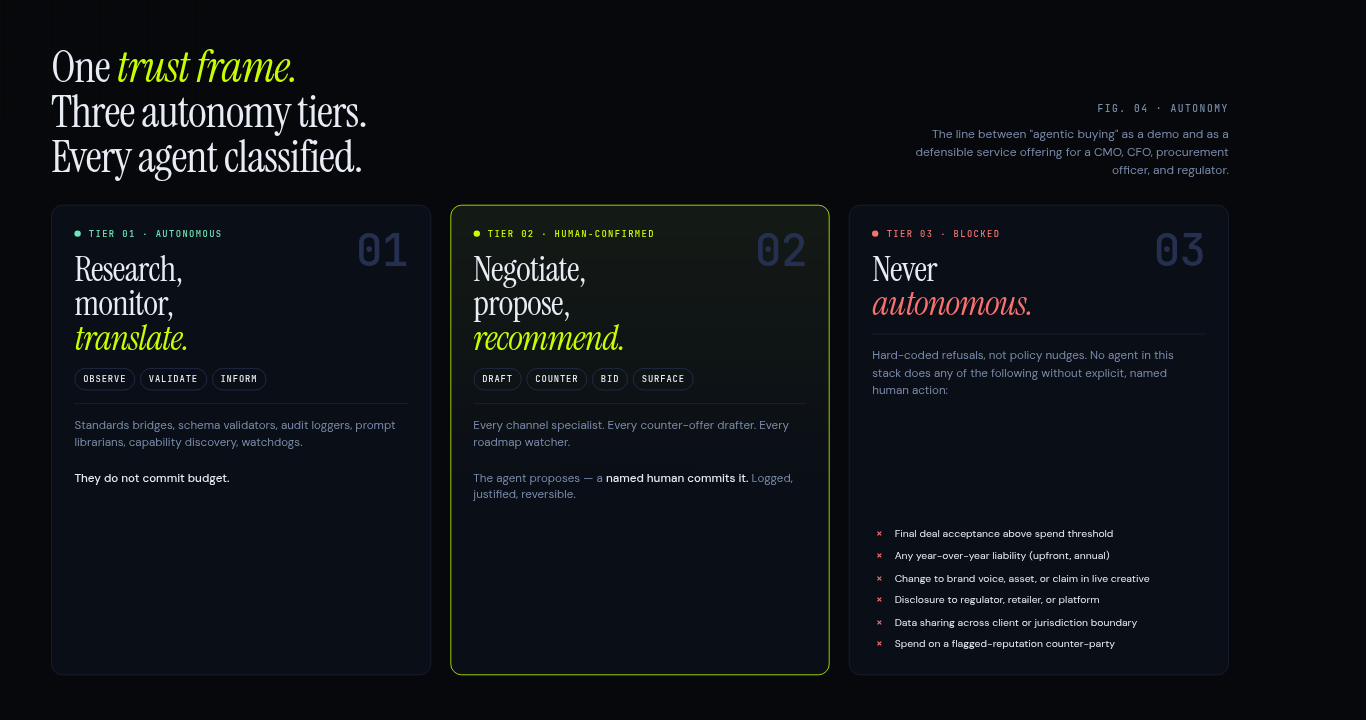
Every agent in this stack lives inside the same three-tier autonomy frame as Index № 01. This index applies it to the harder case — agents that transact, not just recommend.
Standards bridges, schema validators, audit loggers, prompt librarians, capability discovery agents, watchdogs. They observe, validate, and inform. They do not commit budget.
Every channel specialist. Every counter-offer drafter. Every roadmap watcher. The agent proposes the deal, the bid, the response, the decision — a named human commits it. Logged, justified, reversible.
No agent in this stack does any of the following without explicit, named human action. Hard-coded refusals, not policy nudges.
The Tier 03 line is the line that lets a holdco put this stack in front of a global CMO, a CFO, a procurement officer, and a regulator. It is the difference between "agentic buying" as a demo and as a defensible service offering.
Three pages, one trust thesis. The cognitive layer, the transacting layer, and the framework that turns either into something a global client will actually sign off on.
The broad catalogue of agentic services across the agency, the brand, and the holdco. Use it to find the cognitive agents — strategy, brand, creative, intelligence, advisory, measurement, production, CRM.
The framework that turns any agent in either index into something a client will sign off on. The 10 heuristics, the autonomy mapping, the 90-day roadmap, the 10-dimension scorecard.
The transacting layer. The agents that face other agents, the standards bridges, the inline trust, and the channel specialists demanded by the agentic upfronts of May 2026.
Three pages, one trust thesis — agents earn the right to act by being designed for it.
auxfirst is an agentic experience design agency. We don't license agents and we don't resell platforms. We design the trust layer — the visible intent, the evidence, the autonomy boundaries, the escalation paths, the memory policies, the audit trails — that turns one of these 50 specialist ideas into a service a holding company can actually put in front of a global FMCG, retail, CPG, or platform client.