Advertising Agencies Are About to Hit the Agentic Trust Crisis
For the last two years, advertising agencies have treated AI as a productivity story.
More concepts. More copy. More versions. More decks. More insights. More speed.
That made sense during the first wave of generative AI adoption. The early promise was simple: take a task that used to take hours and compress it into minutes.
But the next phase is different.
AI is moving from generation to delegation.
It is no longer just writing options. It is starting to recommend audiences, interpret briefs, summarize research, generate campaign territories, classify replies, analyze performance, optimize media, prepare client decks, trigger next actions, and shape decisions inside agency workflows.
That changes the question.
The old question was: Can AI produce this?
The new question is: Can we trust this agent to act inside this workflow, for this client, under these conditions, without damaging the brand, the relationship, or the business?
Most agencies are not ready for that question.
And that is the agentic trust crisis.
A practical guide to building agentic AI your clients, teams, and brand can actually rely on.
From AI tools to AI agents
The agency AI conversation has mostly been framed around tools. Which model, which image generator, which workflow platform, which prompt library.
But agentic AI changes the center of gravity.
A tool waits for a human to use it. An agent is given a goal, context, permissions, and some degree of autonomy. It can reason through a task, call tools, retrieve information, make recommendations, take actions, or escalate issues.
In advertising, this could look like: an agent that monitors competitor campaigns. An agent that turns client briefs into strategy territories. An agent that researches audience tensions. An agent that generates first-round creative routes. An agent that checks whether claims are supported. An agent that prepares weekly performance narratives. An agent that recommends campaign optimizations. An agent that drafts client emails. An agent that decides which human should review what.
This is not science fiction. Many agencies are already experimenting with pieces of this. The problem is that most are doing it without a clear trust architecture.
They know what the agent can do. They do not know what the agent should be trusted to do.
The trust problem is already visible
The industry is already signaling discomfort.
Digiday reported that agencies are concerned about how much to trust generative AI, especially around copyright risk. One cited report found that 63% of agencies were concerned about copyright infringement when using AI-generated content and image creators. [1]
Campaign has warned that brand safety and AI safety are now connected, noting that generative AI may produce factually incorrect or misleading claims that expose organizations to reputational damage and consumer trust risks. [2]
Marketing Week has reported growing consumer discomfort around AI in advertising. According to research from YouGov and Meltwater, 89% of consumers believe AI-generated content should be disclosed by brands, while 54% of UK consumers say AI is not acceptable to use in product advertising. [3]
AdExchanger has also pointed to a credibility gap in AI adoption, reporting that only 30% of advertisers trust AI to do advertising tasks for them. [4]
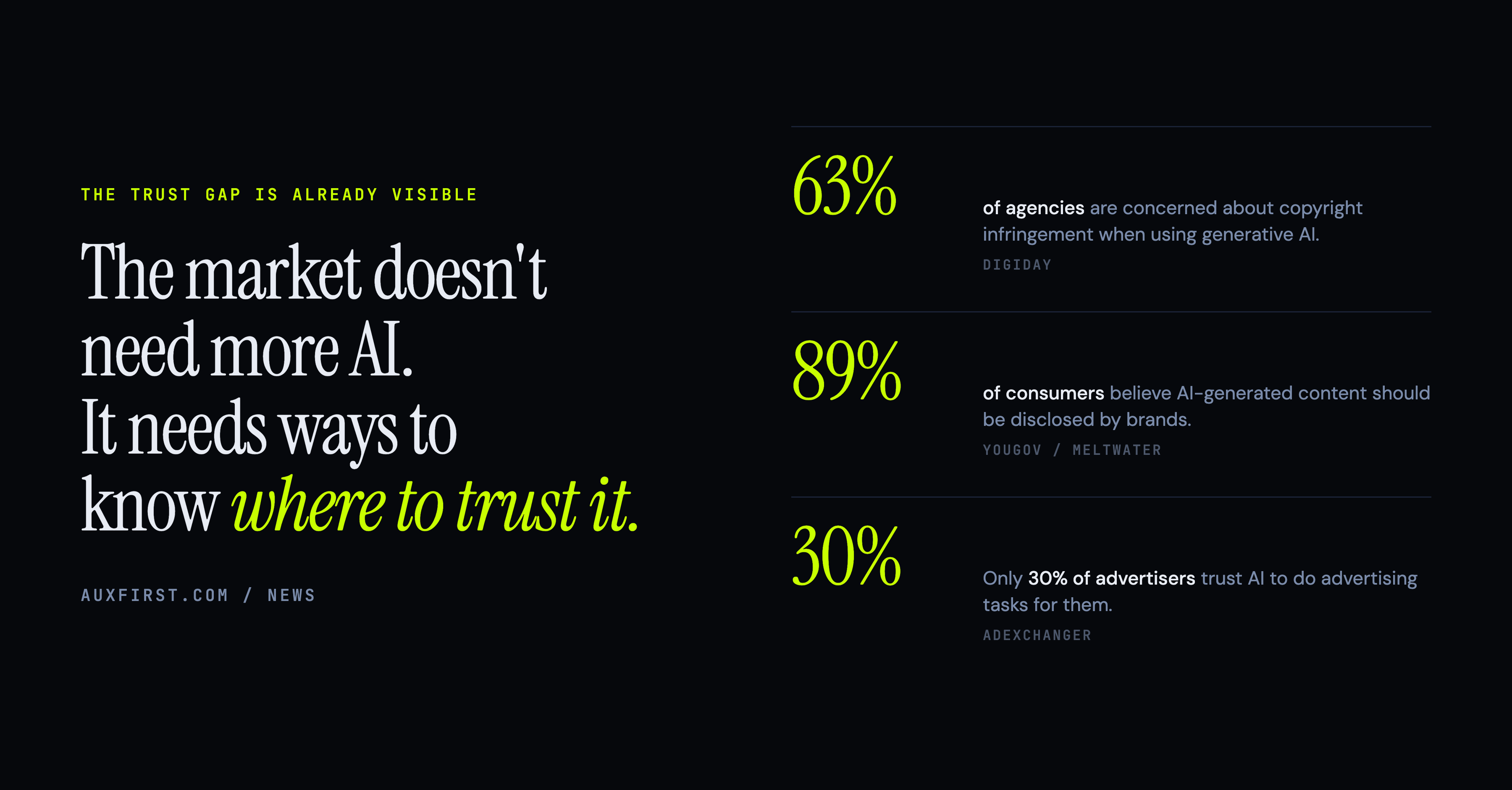
These are not isolated concerns. They are early symptoms of a deeper shift. The market does not only need better AI capabilities. It needs better ways to decide where AI can be trusted.
The problem is not that AI makes mistakes
Humans make mistakes too.
The real problem is that AI changes the speed, scale, opacity, and ownership of mistakes.
A strategist can misread a brief. But an AI strategy agent can misread a brief and generate ten polished territories that look plausible enough to pass through a busy team.
A junior copywriter can write an unsupported claim. But an AI content workflow can produce hundreds of variations of that claim across assets, landing pages, scripts, emails, and social posts.
A media planner can overinterpret weak signals. But an optimization agent can act on weak signals continuously, reallocating attention, spend, and recommendations before anyone understands the pattern.
The issue is not simply error. The issue is unearned confidence at machine speed.
The four trust gaps inside agency AI
At AUX, we think about agentic trust across four dimensions:
Functional trust — Does the AI do the task correctly?
Contextual trust — Does it understand the brand, client, category, audience, market, and moment?
Judgment trust — Does it know when to decide, when to ask, when to escalate, and when to stop?
Advocacy trust — Does it protect the client, the brand, the team, the relationship, and the long-term outcome?
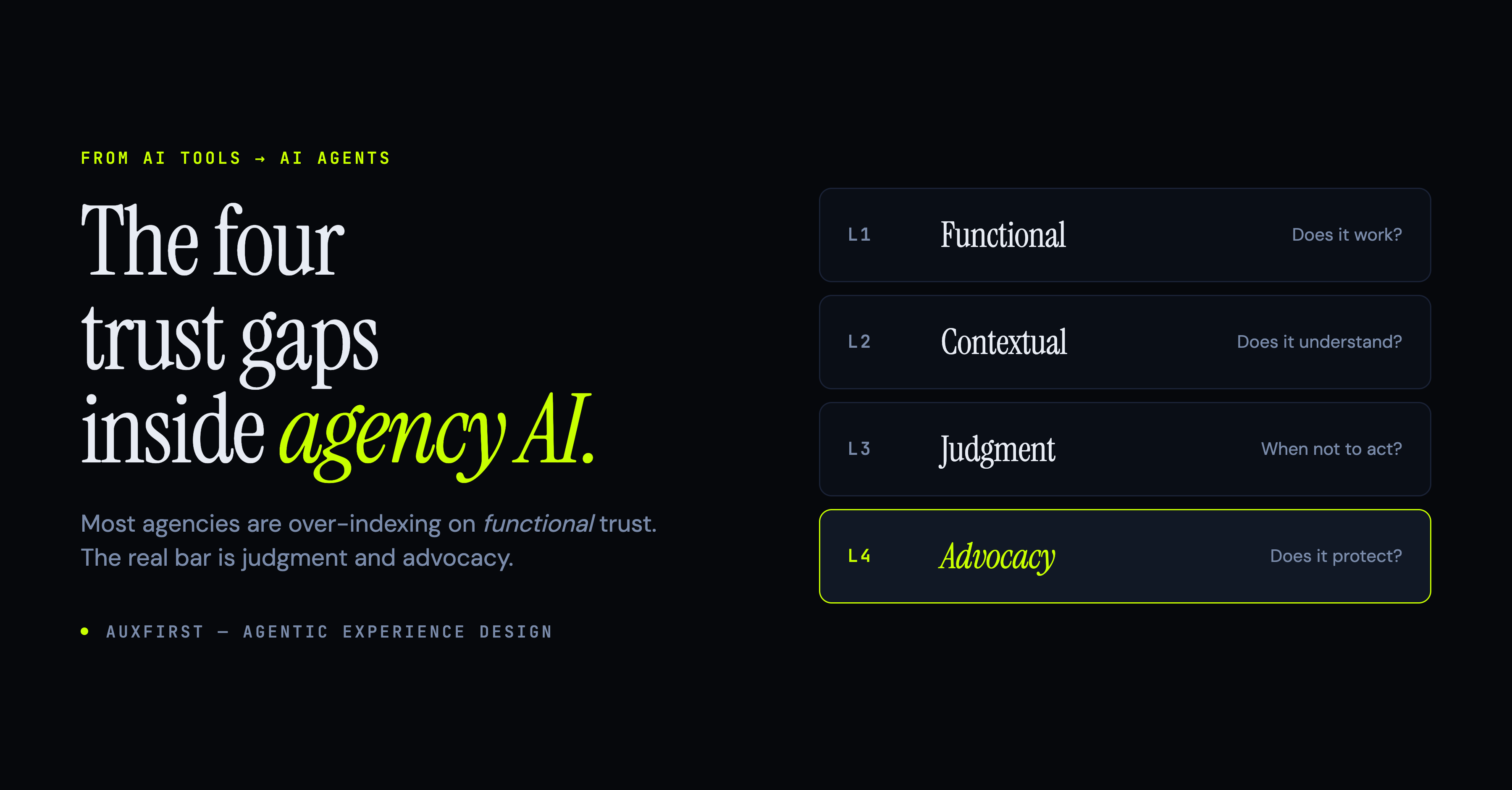
Most agencies are currently over-indexing on functional trust. They test whether the AI can produce something. But functional trust is only the first layer. An AI workflow can be functional and still be dangerous — completing a task while misunderstanding the brand, producing a strong-looking recommendation while ignoring client politics, optimizing toward a short-term metric while damaging long-term trust.
This is where the agentic trust crisis begins.
Functional trust: "Does it work?"
Functional trust asks whether the AI can reliably perform the job it was given. This is where most AI pilots start — and that is fine. But the danger is mistaking functional performance for readiness.
A workflow that works in a demo may fail with messy inputs, vague briefs, incomplete data, last-minute client changes, conflicting stakeholder feedback, or culturally sensitive topics. Functional trust requires evidence — not vibes, not excitement, not "the output looked pretty good." Evidence: what was tested, against which inputs, with what edge cases, who reviewed it, what failure modes appeared, what happens when the agent is uncertain.
Contextual trust: "Does it understand the world around the task?"
Advertising is context-heavy work. A campaign idea is not good in isolation. It is good for a specific brand, in a specific category, for a specific audience, at a specific cultural moment, with a specific business goal, under specific constraints.
This is where generic AI output becomes dangerous. It may be fluent, but not situated. It may understand the words in the brief but not the politics behind the brief. It may know the category but not the brand's history. It may know the audience segment but not the emotional tension.
Agencies feel this when AI work is technically correct but strategically hollow. The copy is clean, but not distinctive. The insight is plausible, but not sharp. The recommendation sounds smart, but does not reflect the client's actual situation.
Judgment trust: "Does it know when not to act?"
Judgment is the layer most agencies underestimate. AI can generate, summarize, classify, and recommend. But advertising work is full of moments where the right move is not to produce more — it is to pause, challenge, escalate, or ask a better question.
A brief may be too weak to act on. A client request may conflict with the brand strategy. A cultural reference may be too sensitive. A claim may need legal review. A campaign idea may be effective but reputationally risky.
Judgment trust is the difference between an AI assistant and an AI colleague. A trustworthy agent needs clear boundaries: what can it decide alone, what can it recommend but not execute, what requires human approval, what should stop the workflow entirely.
Advocacy trust: "Does it protect what matters?"
The highest form of agentic trust is advocacy. This is where an AI system is not merely completing tasks — it is helping protect the integrity of the work: the client's brand, the consumer's trust, the quality of the creative, the accuracy of claims, the agency's reputation.
An advocacy-oriented agent might say: This brief is not ready. This claim is not supported. This creative route is too close to a competitor. This report overstates what the data can prove. This output should not go to the client yet.
That is the difference between AI as a content machine and AI as a trust-aware workflow partner.
The four-layer trust model — applied to ad agency operations, client work, and agentic workflows.
Why agencies are especially exposed
Advertising agencies are uniquely vulnerable to the agentic trust crisis because agency work sits at the intersection of speed, ambiguity, taste, client service, commercial pressure, and public reputation.
Most agency workflows are not clean systems. They are messy human systems. A brief is rarely just a brief — it contains business pressure, stakeholder politics, category assumptions, brand memory, budget constraints, timeline anxiety, and unspoken expectations. A creative idea is rarely just an idea. A media recommendation is rarely just a number. A client deck is rarely just information — it is persuasion, reassurance, evidence, narrative, and relationship management.
AI can help with all of this. But it can also flatten all of this.
The agency that treats AI as a generic production layer will create generic work faster. The agency that treats AI as a trust-designed operating layer can create better work with more confidence.
The hidden danger: junior teams may overtrust while senior teams undertrust
Junior employees may overtrust AI because it sounds senior. It gives structured answers. It explains itself confidently. It produces finished-looking work. But junior people may not yet have the pattern recognition to see what is missing — when an insight is shallow, when a recommendation is politically naive, when a brand voice is technically correct but emotionally wrong.
Senior teams, meanwhile, may undertrust AI because they cannot see the evidence trail. They do not know what sources were used, what assumptions were made, what the agent ignored, whether the output is repeatable.
So agencies end up with a strange trust split. The people who should be cautious may trust too quickly. The people who could scale the system may resist because they cannot verify it.
A trust architecture helps resolve both problems. It gives junior teams clearer boundaries. It gives senior teams clearer evidence.
The client will not care about your AI stack
Clients are unlikely to reward agencies simply for using AI. They will reward agencies for better thinking, faster delivery, stronger evidence, sharper creative, more responsive service, and better business outcomes.
They will not forgive AI that damages trust. They will not care that the workflow was automated if the recommendation is weak. They will not care that the report was generated quickly if the conclusion is wrong. They will not care that the campaign was optimized by an agent if the brand feels less human.
This is why AI trust cannot remain an internal operations topic. For agencies, AI trust is becoming part of client trust. If the agency uses AI to shape the work, then the agency needs to be able to explain how that AI is governed, reviewed, constrained, and improved. Not in a defensive way — in a professional way. The same way agencies explain their strategic process, creative process, or measurement methodology.
The agency AI maturity curve
The next phase of agency AI maturity will not be defined by who has the most tools. It will be defined by who has the clearest trust model.
Most agencies are somewhere between Level 1 and Level 3. The industry conversation is pulling them toward Level 4. But without Level 5 thinking, Level 4 becomes risky. That is the agentic trust crisis.
The new agency advantage
There is a positive version of this story.
The agencies that solve trust will have an advantage. They will be able to use AI more confidently. They will move faster without becoming reckless. They will show clients how AI improves the work instead of hiding it behind the curtain. They will protect their people from low-value labor while preserving human judgment.
Because the future agency pitch will not be: "We use AI." Everyone will use AI.
The stronger pitch will be: "We know where to use AI, where not to use it, how to govern it, how to evidence it, and how to protect your brand while moving faster."
That is a different kind of agency. Not just AI-enabled. Trust-enabled.
The real crisis
The agentic trust crisis will not arrive as one big scandal. It will arrive quietly.
A client loses confidence in a deck that feels generic. A strategist realizes the insight was fabricated. A creative director sees the work becoming flatter. A junior team stops developing judgment. A media recommendation cannot be explained. A claim goes out without proper evidence. A client asks how AI was used and the agency has no clear answer.
That is how trust breaks. Slowly, then suddenly.
Advertising agencies are not heading into an AI tooling crisis. They are heading into an agentic trust crisis. And the agencies that win will not be the ones that automate the most.
They will be the ones that know what deserves to be automated, what must remain human, and how AI earns the right to act.
Because in the next era of advertising, speed will be easy. Trust will be the hard part.
If this resonated, the ebook goes deeper — practical frameworks for building AI your agency and clients can rely on.